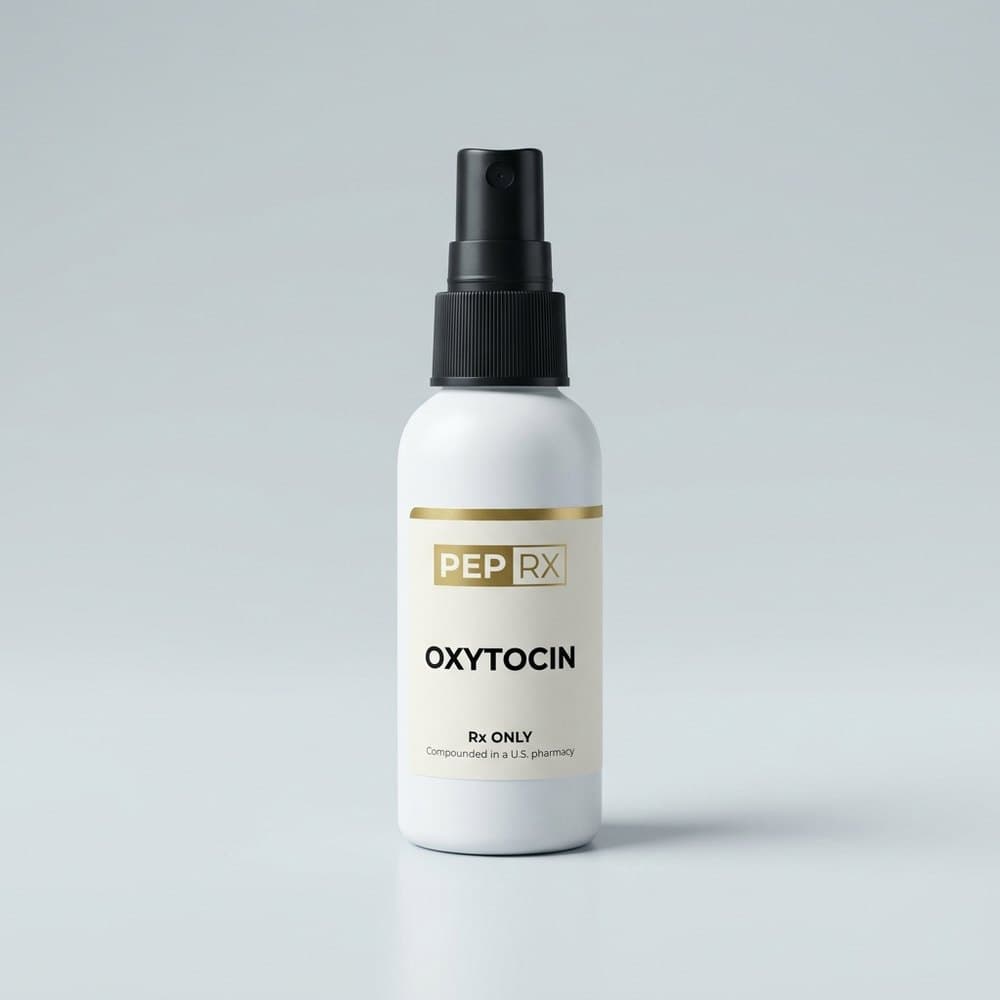
Oxytocin
Oxytocin is a naturally occurring nonapeptide hormone, here prepared as an intranasal formulation, understood to play a role in social bonding, trust, and emotional connection. Within a physician-supervised setting, physicians consider it for supporting prosocial behavior and affiliative response, where clinically appropriate.
- Personalized guidance, one-on-one with your care team.
- If a physician determines it isn't the right fit, you pay nothing.
$233 / month
Same vial, shipped monthly — a lower rate for staying under continuing physician care. Skip or cancel anytime.
Cancel or pause anytime · Ships only after physician approval
You complete a secure medical intake first. A licensed U.S. physician reviews it — typically within 24 to 48 hours — and you are only charged once a physician approves your protocol. Each completed screening remains valid for 12 months. See how it works · Meet our physicians
Mechanism of action
How Oxytocin works at the receptor, signaling, neural, and regulatory levels — shared to inform, never to promise an outcome. Your physician confirms what is appropriate for you.
Receptor Activation
Oxytocin is understood to bind primarily to the oxytocin receptor (OXTR), a G protein-coupled receptor expressed across the brain, mammary tissue, uterus, and cardiovascular system. It can also interact, with lower affinity, with vasopressin receptor subtypes, which may contribute to some of its broader physiological signaling. Intranasal delivery is understood to be a route intended to engage central OXTR populations.
Cell Signaling
Upon OXTR engagement, the receptor couples predominantly to Gq/11 proteins, which is understood to activate phospholipase C, generate inositol trisphosphate, and trigger subsequent intracellular calcium release. This calcium signaling is linked to downstream effects on protein kinase C and MAPK cascades. Context-dependent coupling to other G protein families is also understood to occur, giving signaling outcomes that vary by tissue.
Neural Activity
Oxytocin is understood to act as a neuromodulator across circuits in the hypothalamus, amygdala, and reward-related regions. It is understood to influence the salience of social cues and is discussed in relation to trust, affiliative behavior, and stress-response modulation. These central effects remain an active and evolving area of understanding rather than established outcomes.
Regulatory Pathways
Beyond the CNS, oxytocin is understood to contribute to autonomic and neuroendocrine regulation, including modulation of the hypothalamic-pituitary-adrenal axis and parasympathetic tone. It also has peripheral roles relating to smooth muscle and cardiovascular signaling. It is additionally associated with inflammatory and wound-healing pathways, though these remain preliminary.
Built around you, never one-size-fits-all
Who it's for
A physician might consider this for adults interested in support around social connection, emotional well-being, and stress-related goals, evaluated case by case under medical supervision.
What's included
Includes the intranasal oxytocin preparation (10mg / 15mL), a physician evaluation, and personalized usage guidance.
Ongoing care
Your physician stays involved beyond the first order — check-ins, dose guidance, and refills under continuing supervision.
Prescribed, compounded, supervised.
This is not a research chemical bought from an anonymous importer. Every therapy is prescribed by a licensed physician and compounded for you by a licensed U.S. pharmacy — American-made, on your order.
- Compounded by licensed U.S. pharmacies to USP standards
- Compounded by a licensed U.S. pharmacy on your prescription
- Reviewed and prescribed by U.S.-licensed physicians
- Cold-chain handling and discreet, tracked delivery
Related therapies
Begin Oxytocin with a physician evaluation
One honest price, evaluation included. A licensed physician reviews your case before anything ships — with a full refund if it isn't the right fit.